
Picture this. It’s a Tuesday night in Austin. A homeowner’s water heater just gave up. She doesn’t open Google. She opens ChatGPT and types: “who’s the best emergency plumber in Austin with good reviews and fair pricing?“
ChatGPT thinks for two seconds and spits out three names. One of them gets the call. The other two? They never even knew the conversation happened.
This scene is now playing out 2.5 billion times a day. ChatGPT crossed 900 million weekly active users in February 2026, more than double a year ago and roughly 5–6% of all that activity is people actively trying to figure out who to hire, what to buy, and where to go. Do the quick math: that’s somewhere around 45 to 54 million buying-intent conversations every single week, happening completely outside of Google.
Here’s the part that should really get your attention. Visitors who come from AI search convert at 14.2% on average, about 4.4x better than regular organic search traffic (Semrush, 2026). Fewer visitors. Way better customers. That’s the trade.
So the real question isn’t whether your local business should care about ChatGPT. The question is whether you’ll be one of the three names it recommends or one of the ones that never gets mentioned.
This guide is the playbook to rank local businesses on ChatGPT . Real research, real tactics, zero fluff. And the same framework works whether you’re a dentist in Austin, an HVAC contractor in Brisbane, a boutique hotel in the Cotswolds, a café owner in Toronto, or a yoga studio in Bengaluru because ChatGPT’s algorithm doesn’t care about your zip code. It cares about signals. Let’s talk about which ones, and how to earn them.
Table of Contents
Why ChatGPT Matters for Local Businesses?
A year ago, “AI search” was a curiosity. In 2026, its infrastructure is the fifth most-visited website in the world, sitting on 60% to 80% of the AI chatbot market depending on whose methodology you trust. Microsoft Copilot, which runs on the same Bing backbone, adds another ~13% on top. Together, those two drive the conversation for the vast majority of AI search queries happening on the planet right now.
The geographic spread is what should really wake up local business owners. The United States has roughly 77 million monthly active users. India crossed 100 million weekly users in early 2026. The mobile app alone pulls 557 million monthly active users globally, with strong adoption across the UK, Australia, Canada, and Southeast Asia. And 92% of Fortune 500 companies now use ChatGPT in some form, which means the people making B2B buying decisions in your city are already trained to ask AI before they ask Google.
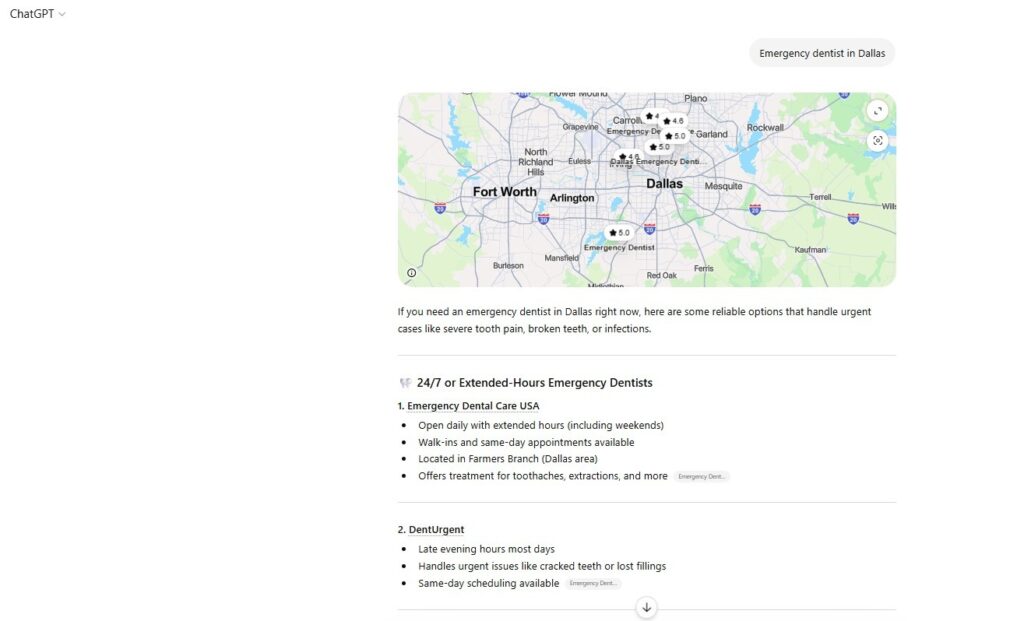
Here’s the stat that should really stop you. Google’s AI Overviews now trigger 18% of all searches and 57% of long-tail queries, which is exactly where local commercial intent lives. Of those AI Overview searches, 43% end with zero clicks to any external site. In Google’s full AI Mode, that number rockets to 93%. The blue-link economy is being eaten alive in real time.
The pattern is unmistakable. Discovery is shifting from a list of ten links to a single recommended answer, and the businesses that learn to win that single answer will dominate their local market. The ones that don’t will quietly disappear from their customers’ consideration set without ever realizing why the phone stopped ringing.
If you’ve already been investing in traditional local SEO, the good news is you’re not starting from zero. The bad news is that what got you ranked on Google isn’t automatically what gets you recommended by ChatGPT. For a clear breakdown of where the two disciplines overlap and diverge, our upcoming deep-dive on AI SEO vs traditional SEO explains the real differences point by point.
How ChatGPT Actually Picks a Local Business to Recommend
Let’s get one thing out of the way: ChatGPT does not “crawl and rank” like Google. There is no SERP, no position 1, no keyword bid. Instead, ChatGPT works on a synthesis model called retrieval-augmented generation (RAG).
When you ask it “who’s the best emergency plumber in Calgary with good reviews and fair pricing,”
ChatGPT does three things:
First, it pulls from its training data, billions of pages, threads, directories, reviews, and news articles it has already absorbed. This is where consensus matters. If dozens of independent sources on the web describe your plumbing company as trustworthy and name your city, ChatGPT’s neural network has already learned that association.
Second, for queries that need current information, it fires off live web searches (primarily through Bing, because OpenAI and Microsoft are deeply integrated). This is why a strong Bing presence matters more than most local business owners realize. Research from Joe Youngblood showed that local businesses with verified Bing Places listings and recent reviews rank 3–5x higher in ChatGPT’s local recommendations than competitors without Bing verification.
Third, it synthesizes everything into a single, confident recommendation. No ten blue links. No scrolling. Just: “For emergency plumbing in Calgary with strong reviews and fair pricing, consider X, Y, or Z.”
The practical implication is blunt. You are no longer competing for a click, you are competing for a mention. And you win the mention by looking, across the entire internet, like the most obvious, most consensus-backed, most frequently-cited answer to the exact kind of question your customer is asking.
This shift from clicks to citations is the core of generative engine optimization, and it rewards a fundamentally different kind of marketing, one where being quoted on a respected third-party site counts for more than ranking #4 in Google.
Where ChatGPT Actually Pulls Local Business Data From
In early 2026, Similarweb analyzed roughly 600,000 citation events across ChatGPT and Google AI Mode in the United States. The pattern is striking. Wikipedia and Reddit each account for roughly 12–13% of all ChatGPT citations, which puts them in a class of their own. Below them sits a long tail of authoritative publishers and user-generated platforms.
For local businesses specifically, here’s the citation map you need to understand:
| Source Type | Why It Matters for Local Ranking | Action |
| Google Business Profile | Primary local trust signal; feeds Bing + ChatGPT indirectly | Complete every field; post weekly |
| Bing Places | Direct retrieval source for ChatGPT | Verify listing; claim duplicates |
| Yelp, Yellow Pages, BBB, TripAdvisor | Cited heavily for “best of” prompts | Complete profiles; request reviews |
| Industry-specific directories | Vertical authority | Claim and optimize every relevant one |
| Reddit threads | 2nd most-cited domain in ChatGPT | Participate authentically in local subreddits |
| “Best of” listicles | 21.9% of AI Mode/ChatGPT/Perplexity citations are listicles | Get featured in local “top 10” articles |
| PR and news mentions | High-authority citation pathway | Run newsworthy campaigns; use HARO / Qwoted |
| Top source for professional/B2B queries | Publish city-tagged thought leadership | |
| Wikipedia | Most-cited domain globally | Only viable for established brands |
Two more data points worth locking in. First, Reddit and Wikipedia dominate cross-surface: across every AI surface tested, user-generated discussion platforms and encyclopedic references occupy the top citation slots.
Second, the winners’ circle is small; the top 10 domains take 46% of all ChatGPT citations in a topic, and the top 30 take 67%. If your business isn’t showing up on those dominant sources in your niche and location, you aren’t in the conversation.
The 8-Pillar Framework to Rank Local Business on ChatGPT
This is the full system. Work through it in order each pillar compounds on the ones before it.
Pillar 1: Fix the Foundation, Google Business Profile + NAP Consistency
Before anything fancy, your Name-Address-Phone (NAP) data needs to be identical everywhere it appears online. AI models build internal confidence in your business as a real entity by matching these data points across sources. A discrepancy on your Yelp listing vs. your Google Business Profile vs. your website footer is a trust-killer.
Run a free audit on tools like BrightLocal, Whitespark, or Moz Local to find inconsistencies. Fix them on:
- Google Business Profile (the primary anchor)
- Your website’s contact page and schema
- Facebook Business Page
- Apple Maps / Apple Business Connect
- Every directory where you appear
On Google Business Profile specifically: complete 100% of the profile, add 20+ real photos, enable messaging, post weekly updates, and respond to every review, positive and negative, within 48 hours. These are the same fundamentals that would boost you in Google’s Local Pack, but now they also feed Bing and, through Bing, ChatGPT.
Pillar 2: Claim and Optimize Bing Places
This is the single most under-exploited tactic for ChatGPT visibility. Because ChatGPT uses Bing’s index for real-time retrieval, a complete Bing Places listing is the closest thing you can get to a direct line into ChatGPT’s local recommendations. Most business owners never touch Bing. That is your opening.
Go to Bing Places for Business, verify ownership, complete every section, hours, categories, attributes, photos, service areas and keep it updated quarterly. If you are a multi-location business, verify every single location.
Pillar 3: Blanket the Right Directories for Your Industry and Country
Beyond the global Big Four (Yelp, Yellow Pages, BBB, TripAdvisor), you need vertical and geographic coverage:
- USA: Angi, HomeAdvisor, Thumbtack, Nextdoor, Avvo (lawyers), Zocdoc (healthcare), Healthgrades
- Canada: 411.ca, Canada411, Cylex, Hot Frog
- UK: Yell, Thomson Local, Freeindex, Checkatrade
- Australia: True Local, White Pages AU, Hotfrog AU, ServiceSeeking
- India: Justdial, Sulekha, IndiaMART, UrbanClap / Urban Company
AI tools don’t just read your website, they synthesize everything the web “knows” about you. The more reputable platforms confirm the same facts (that you exist, where you serve, what you do, and that people like your work), the more likely ChatGPT, Perplexity, Claude, and Microsoft Copilot will all reach the same conclusion when a customer asks.
Pillar 4: Build a Website AI Can Actually Read
This is where most local businesses unknowingly block themselves from AI search. A few non-negotiables:
I. Stick with HTML over JavaScript-heavy frameworks. Research published by OtterlyAI in April 2026 found that AI engines often ignore Markdown-only pages and heavily JavaScript-rendered content. A WordPress site with a clean theme will outperform a fancy React SPA every time when it comes to AI retrieval.
II. Add schema markup everywhere. At minimum: LocalBusiness schema on your contact page, Service schema on each service page, FAQ schema on your FAQ sections, Review schema to surface aggregate ratings, and Article schema on blog posts. This turns your site into machine-readable facts.
III. Create an llms.txt file. This emerging standard is a mini-index that tells AI crawlers which pages matter most on your site. Put it at your domain.com/llms.txt and list your key service pages, location pages, FAQs, and pillar content.
IV. Fix your speed. AI crawlers are impatient, sub-2.5-second page loads are the minimum. Use Google PageSpeed Insights, compress images, lazy-load, remove unused scripts.
V. Publish clear, direct answers. This is where the Bottom Line Upfront rule matters. Every page should open with a 2–3 sentence paragraph that directly answers the question the page is about. AI systems extract those answer blocks far more often than they extract long preambles.
Pillar 5: Own Your City + Service Combinations with Location-Specific Content
This is where topical authority gets built. You don’t win “plumbing Brisbane” with a single page called “Plumbing Services.” You win it with 30 pages covering specific combinations: emergency plumbing West End Brisbane, leak detection Fortitude Valley, gas hot water repairs Paddington, blocked drains New Farm, burst pipe repair Kangaroo Point, and so on.
The principle is simple: AI is looking for the business that best matches a specific prompt. A prompt like “where can I get same-day leak detection in Fortitude Valley” needs to match a page that actually addresses same-day leak detection in Fortitude Valley. The more your website covers the long tail of real customer questions, the more often you become the obvious answer.
Plan your content around real prompt patterns:
- “best [service] in [neighborhood]”
- “how much does [service] cost in [city]”
- “[service] near me open now”
- “[competitor] vs [you] in [city]”
- “emergency [service] [city] [time window]”
Publish these consistently, a minimum of one well-researched, long-form post per week. Consistency matters because AI platforms preferentially cite fresher content (Ahrefs found AI systems prefer content roughly 27.5% fresher than baseline), so a stale site falls behind a prolific one.
Pillar 6: Engineer Third-Party Brand Mentions
Your own website is the floor, not the ceiling. The real ceiling is how many other respected sources on the internet mention your business in the right context.
Three workflows actually move the needle:
Get featured in local “best of” listicles. These dominate AI citations for commercial queries. Find the lists that already rank on Google for “best [your service] in [your city]”, those are the exact URLs ChatGPT and Perplexity pull from. Reach out to those publishers with a pitch, a case study, or (often necessarily) a sponsored placement budget. ChatGPT does not distinguish between organic and paid brand mentions, they both count.
Pitch local and industry media. Tools like HARO (USA), Qwoted, SourceBottle (Australia), and ResponseSource (UK) connect journalists with expert sources. Getting quoted in Forbes, Business Insider, The Times of India, The Sydney Morning Herald, The Globe and Mail, or any respected local outlet builds exactly the kind of authority signal that AI systems weigh heavily.
Publish industry reports. Original data published on your site, “We surveyed 500 homeowners in Melbourne about renovation budgets in 2026”, earns citations on autopilot for 6–12 months after publication. Push these through press release distribution (PR Newswire, EIN Presswire, PressWire) so hundreds of secondary outlets pick them up.
For a deeper tactical breakdown of these tactics, our upcoming guide on the best AI SEO tools walks through exactly which platforms make this outreach repeatable.
Pillar 7: Reviews, Volume, Recency, and Sentiment
A 2026 study documented by Wildnet Technologies found that brands with 80%+ positive sentiment across reviews rank higher on ChatGPT than competitors with equal citation counts but neutral sentiment. AI doesn’t just count your reviews, it reads them.
Practical targets:
- At least 100+ reviews on Google, ideally 250+
- Consistent cadence (e.g., 5–10 new reviews monthly, not 100 dumped in one week)
- Average rating ≥ 4.5 stars
- Owner responses on every review
- Reviews across multiple platforms, not just Google (Yelp, Facebook, industry-specific sites)
Set up an automated review request flow, a text or email 24 hours after service completion is the sweet spot. Never buy reviews; platforms are getting aggressive about detection, and a penalty here is catastrophic for AI visibility.
Pillar 8: Show Up on Reddit, YouTube, and Community Platforms
Reddit is ChatGPT’s second most-cited domain. YouTube is the third most-cited domain across all AI search engines. Ignoring them is leaving the two biggest citation sources on the table.
For Reddit: find the active subreddits in your city (r/melbourne, r/toronto, r/london, r/bangalore) and your industry (r/homeimprovement, r/legaladvice, r/fitness). Participate genuinely for months before ever mentioning your business. Answer questions, give useful advice, build karma. When someone asks a question your business legitimately answers, then and only then, mention it. AI models extract trust from authentic, voted-up Reddit discussion in a way they do not extract from promotional pages.
For YouTube: publish keyword-rich, location-specific videos. “How much does a bathroom renovation cost in Sydney in 2026” as a 10-minute walkthrough video with a detailed description and accurate transcript earns citations for years. ChatGPT parses YouTube transcripts directly; make sure yours are accurate.
Optimizing Across All AI Search Engines, Not Just ChatGPT
Ranking on ChatGPT alone is an incomplete strategy. A full AI visibility plan covers every major answer engine, because different customers use different tools.
ChatGPT dominates the conversation with roughly 60–80% of AI chatbot market share in 2026 (the range depends on methodology), pulling its real-time data from Bing combined with its training corpus.
Microsoft Copilot, sitting at around 13% market share, shares the exact same Bing backbone, which means the work you do for ChatGPT pulls Copilot along for free.
Google AI Overviews and AI Mode appear in roughly 18% of Google searches and 57% of long-tail queries, but they’re a separate discipline closer to classic SEO, Google’s own index is the retrieval source, and Google-owned properties like YouTube and Reddit (via partnership) get cited heavily.
Perplexity holds around 6–7% market share but punches above its weight for research-driven users; it leans heavier on original research, structured data, and citations-first content, so publishing proprietary data wins here.
Claude sits at 2–4% but is rapidly growing in professional and developer use cases; it favors high-quality editorial content and structured documentation, citing fewer sources but rewarding depth.
The strategic takeaway is simple: optimizing for ChatGPT covers most of the ground, Copilot comes free, and Google AI Overviews need a parallel SEO push.
Our dedicated guide on “how Google AI Overviews choose citations” digs into that side, and our upcoming walkthrough on “how to optimize for Perplexity AI” covers what changes when you target the research-heavy crowd.
How to Actually Track Whether This Is Working
You cannot improve what you cannot measure. There are three metrics that matter in 2026:
1st: AI mentions: How often your brand is named in AI responses for your target prompts, with or without a link back. Tools like Ahrefs Brand Radar, Profound, Otterly.ai, SE Ranking’s AI Visibility Tracker, and Rocketito track this across ChatGPT, Perplexity, Gemini, Copilot, and AI Mode.
2nd: AI citations: The subset of mentions that include a link back to your site. These are the most directly measurable wins.
3rd: AI-sourced traffic: Visits from ai.com referrers in Google Analytics 4. Filter by source/medium containing “chatgpt.com”, “perplexity.ai”, “copilot.microsoft.com”, or “gemini.google.com”. This traffic tends to convert dramatically better than organic, so even a small volume is meaningful.
Run your tracking on a monthly cadence. For a deeper guide on monitoring, our walkthrough on how to track brand mentions in ChatGPT and Perplexity covers the full toolkit.
The Mistakes That Will Keep You Invisible
A few patterns sink local businesses over and over. Avoid these:
- Pretending AI search is the same as SEO. The overlap is real but partial. A site ranking #1 in Google has only a 58% chance of being cited by ChatGPT; by position 10, that chance falls to 14% (Growth Memo, 2026). Rankings are necessary but insufficient.
- Ignoring Bing. Every hour you spend on Google and none on Bing, your ChatGPT visibility suffers.
- Letting your citation footprint decay. Inconsistent NAP across directories, missing schema, outdated listings; these silently erode AI confidence in you as an entity.
- Writing for keywords instead of prompts. Your customers don’t search “emergency electrician Denver” on ChatGPT, they type “I need a 24/7 electrician in Denver who does commercial work and has good reviews.” Write pages that match that intent.
- Buying fake reviews. Platforms detect patterns; AI models detect inauthenticity through sentiment analysis. The short-term boost is not worth the long-term demolition.
- Trying to hack your way in. There’s no “rank #1 on ChatGPT overnight” shortcut. Press-release spam and fake industry reports get filtered out fast. The businesses winning in AI search are the ones quietly doing the fundamentals better than everyone else.
Your Next Move
Ranking your local business on ChatGPT is not one project, it is a new layer of your marketing that will compound over the next five years. The businesses that started building AI visibility in 2024 and 2025 are now dominating their local prompts while competitors scramble to catch up. The businesses that start in 2026 still have a window, but that window is closing as AI search matures.
If you want a single actionable path forward, start with the three highest-leverage moves: claim and complete your Bing Places listing, audit your NAP consistency across your top 10 directories, and publish one genuinely useful, location-specific long-form article this week. Everything else in this guide builds on that foundation.
For a deeper tactical layer on the adjacent strategies, Technical Kalyan publishes research-backed playbooks on every part of the AI search stack, from how to rank in Google AI Overviews to the full framework for organic AI brand visibility for brick-and-mortar businesses.
Both guides dive into the exact signal-building and citation-earning tactics that make the 8-pillar framework above actually execute in the real world. If you’re serious about owning your local prompts in 2026, read those two next and build a 12-month plan around them.
FAQs on Rank Local Businesses on ChatGPT
1. Can I pay to rank my local business higher on ChatGPT?
A: No. As of 2026, ChatGPT does not offer paid placements inside its organic answers, and any service claiming to “guarantee” a paid spot on ChatGPT is misrepresenting how the system works. You can, however, pay for things that influence ChatGPT indirectly, sponsored content on listicles, press release distribution, PR campaigns, and ads on the platforms ChatGPT pulls from (like Bing). These still count as legitimate citation signals.
2. How long does it take to rank a local business on ChatGPT?
A: For most local service businesses, expect 30 to 90 days to start appearing in ChatGPT responses for narrow, long-tail prompts, and 6 to 12 months for the broader, higher-value commercial queries. Speed depends on your current baseline (existing directory presence, review volume, website quality), how competitive your city-service combination is, and how consistently you execute the 8-pillar framework.
3. Does ranking on Google still matter if AI search is the future?
A: Yes, emphatically. Google still sends roughly 196x more traffic than ChatGPT. More importantly, AI systems like ChatGPT use Bing (and indirectly Google data) as retrieval sources, so your traditional SEO foundation directly feeds your AI visibility. The right framing is not Google or AI search, but Google plus AI search, with each reinforcing the other.
4. What’s the single most important thing for a local business to do first?
A: Claim and fully optimize your Bing Places listing if you haven’t. It’s the most under-exploited, highest-leverage move because ChatGPT pulls live local data through Bing, and the competition on Bing is dramatically lower than on Google. Follow that with review generation on Google Business Profile, volume, recency, and 4.5+ star average are non-negotiable.
5. Do I need a brand-new website to rank on ChatGPT?
A: Not usually. Most local businesses can keep their existing website and simply add the missing layers: LocalBusiness schema, a clear FAQ page with FAQ schema, a service-area content hub, and a sitemap submitted to Google Search Console and Bing Webmaster Tools. If your site is heavily JavaScript-rendered (common with certain no-code builders), a partial rebuild to server-rendered HTML is worth considering, because AI crawlers struggle with JS-heavy pages.
6. How is optimizing for Perplexity, Claude, and Microsoft Copilot different from ChatGPT?
A: Microsoft Copilot shares ChatGPT’s Bing backbone, so optimizing for one largely covers the other. Perplexity weights original research and heavily cites sources, so publishing proprietary data and structuring content with clear, linkable data points helps more. Claude favors high-quality editorial content and clear documentation; it cites fewer sources overall but rewards depth and clarity. Google AI Overviews is closest to classical SEO, ranking well in Google remains the best predictor of being cited in AI Overviews.
7. Can ChatGPT recommend my business in other countries if I only operate locally?
A: Only for location-specific prompts within your service area. ChatGPT is smart enough to filter recommendations geographically; if someone in Manchester asks about a plumber, it will not recommend one based in Phoenix. That said, if your brand has strong authority signals globally (press, Wikipedia, large social presence), it may appear in broader prompts like “best plumbing franchises worldwide.”
8. What role do customer reviews actually play in ChatGPT’s recommendations?
A: A significant one. Research in 2026 found that businesses with 80%+ positive sentiment across reviews rank 3–5x higher in ChatGPT’s local recommendations than competitors with neutral or negative sentiment, even when citation counts are comparable. ChatGPT’s models don’t just count stars, they read review text to infer service quality, specialty, and trust. Respond to every review, keep your rating above 4.5, and aim for a steady monthly cadence of new reviews.
9. Should my local business publish a blog post every week?
A: Ideally, yes, but only if the posts are genuinely useful and location-specific. One well-researched, 1,500-word article that answers a real customer question (“How much does a kitchen remodel cost in Birmingham, UK in 2026?”) beats five thin, generic posts. AI platforms preferentially cite fresher, more specific content, Ahrefs’ research found AI systems favor content roughly 27.5% fresher than baseline, so consistency and specificity both matter.
10. How do I know if my local business is actually showing up on ChatGPT right now?
A: Open ChatGPT and search the exact prompts your customers would use: “best [your service] in [your city]”, “who should I hire for [specific problem] in [neighborhood]”, “compare [competitor] vs [you].” Use an incognito or logged-out session to avoid personalization bias. Run each prompt 3–5 times (ChatGPT responses vary) and record when your business appears. For ongoing tracking, tools like Ahrefs Brand Radar, Profound, Otterly.ai, and SE Ranking’s AI Visibility Tracker monitor your presence across ChatGPT, Perplexity, Gemini, Copilot, and Google AI Overviews automatically.

Kolkata-based SEO consultant and AI Search specialist with 7+ years of experience helping businesses improve their online visibility and organic growth. He specializes in Local SEO, Google Business Profile optimization, AEO, and GEO. With 70+ successful projects across India and international markets, Kalyan helps businesses build stronger visibility across Google Search, Google Maps, ChatGPT, Perplexity, Gemini, Claude, and other AI-powered search platforms. Through Technical Kalyan, he focuses on practical, sustainable search strategies that help local and service-based businesses attract more relevant customers and stay competitive as search continues to evolve in the AI era.