
White label SEO lets your agency offer expert SEO under your own brand without hiring an in-house team. This 2026 guide explains how it works step by step, what it costs, how to choose a reseller partner, and how to resell it for healthy margins.
You’ve just closed a new client. They want SEO. There’s only one problem; you don’t do SEO. Or you do, but your one overworked specialist is already buried, and hiring a full team costs more than the contract is worth.
This is the quiet trap almost every growing agency walks into. You’re great at what you do, whether that’s design, web development, social media, or ads, but the moment a client asks for search rankings, you’re stuck choosing between turning down revenue or delivering something mediocre.
White label SEO services solve exactly this problem. They let you say “yes” to every SEO request, deliver real results, and put your own logo on the report, all without hiring a single SEO specialist.
In this guide, I’ll break down exactly how white label SEO works, what it costs, and how to resell it under your own brand in 2026. No jargon, no fluff; just the practical reality of how agencies quietly deliver SEO they don’t do themselves.
Table of Contents
What Are White Label SEO Services?
White label SEO services are SEO work performed by a specialist provider (like me) that your agency resells to your clients under your own brand. The provider stays completely invisible. Your client only ever sees you.
Think of it the way a supermarket sells its own-brand cornflakes. The supermarket didn’t build a cereal factory; another company made the cereal, packaged it in the supermarket’s box, and shipped it. The customer buys “Tesco cornflakes” and never thinks about who actually produced them.
White label SEO is the same idea, applied to search rankings. You handle the client relationship, the sales, and the branding. A behind-the-scenes partner handles the keyword research, technical fixes, content, and link building. The client gets results with your name on them.
This is different from a referral or a subcontract where the client knows a third party is involved. With white label SEO, the whole point is that they don’t.
How Does White Label SEO Work? (Step by Step)
Here’s what actually happens behind the scenes when you bring on a white label SEO reseller partner.
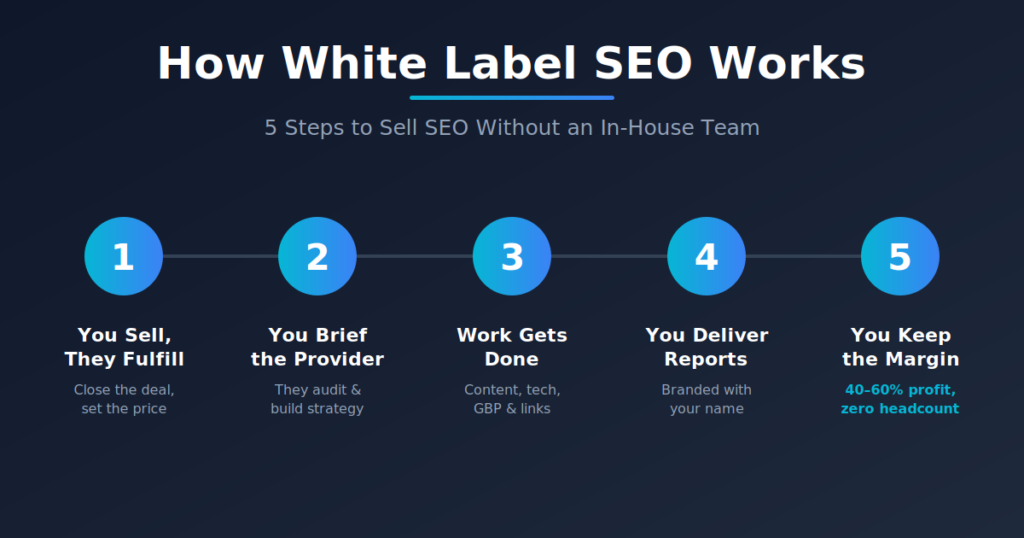
Step 1: You sell, they fulfill. You pitch SEO to your client, close the deal, and set the retainer price. The white label provider never speaks to your client. Your account manager stays the single point of contact.
Step 2: You brief the provider. You pass along the client’s website, goals, and target market. The provider audits the site, identifies opportunities, and builds a strategy, usually within a few days.
Step 3: The work gets done under the hood. This is where the real SEO happens: technical fixes, on-page optimization, content creation, Google Business Profile work, and link building. All of it runs quietly in the background under your brand.
Step 4: You deliver white-labeled reports. The provider sends you monthly reports formatted with your logo, your colors, and your name. You forward them to the client (or send them straight from your dashboard). To the client, it looks like your in-house team produced everything.
Step 5: You keep the margin. You pay the provider wholesale and charge your client retail. The difference is your profit, often 40 to 60%, for work you didn’t have to staff, train, or manage day to day.
The beauty of this model is that it scales. Whether you have one SEO client or fifty, the fulfillment side flexes without you adding headcount.
Why Agencies Use White Label SEO
If you’re weighing whether this model fits your agency, here’s what makes white label SEO for agencies so appealing in 2026.
You add a service without adding a team. Hiring a competent SEO specialist in a competitive market means salary, benefits, training, and the risk they leave in six months taking client knowledge with them. White label SEO turns that fixed cost into a flexible one you only pay when you have work.
You stay focused on what you’re good at. Your agency has a core strength. Every hour spent trying to keep up with Google’s algorithm changes is an hour not spent on that strength. Outsourcing fulfillment lets you sell SEO while staying in your lane.
You capture revenue you’d otherwise lose. Every “sorry, we don’t offer that” is money walking out the door, often to a competitor who does. White label lets you keep that client and that revenue inside your agency.
You get expertise on tap. A good white label partner lives and breathes search all day. You get access to that depth, including newer areas like AI search visibility, without building it yourself.
You look bigger than you are. A three-person agency can offer the same SEO depth as a fifty-person firm. Clients see a full-service agency; they never see the lean team behind it.
White Label SEO Pricing: What Should You Expect?
Let’s talk numbers, because white label SEO pricing is where most agencies get either pleasantly surprised or badly burned.
The monthly retainer is by far the most common and predictable model, and it’s the one most agencies build their own client pricing around.
The key to profit is the gap between wholesale and retail. If a white label partner charges you a wholesale retainer per client, you mark it up and charge your client the retail rate. That markup, commonly 40% to 60%, is your margin.
A word of caution: the cheapest provider is rarely the profitable choice. Ultra-low-cost white label SEO almost always means spun content and spammy links that get your client penalized, and when that happens, your brand takes the blame, not the invisible provider’s. Price your partner on quality and reliability, because their work carries your name.
What to Look for in a White Label SEO Reseller Partner
Not every white label SEO reseller is worth trusting your clients with. Since their work becomes your reputation, choose carefully.
Look for genuine transparency in reporting; you should be able to see exactly what’s being done, not just a vanity graph that goes up. Look for white-hat methods only, because black-hat shortcuts eventually blow up on the client you’re responsible for. Look for clear communication and turnaround times you can build your own client promises around. And in 2026, look for a partner who understands AI search, not just traditional Google rankings, because your clients are increasingly asking whether they show up in ChatGPT, Perplexity, and Google’s AI Overviews, and most old-school SEO shops have no answer for that.
That last point is the real dividing line now. The provider who can get your clients cited by AI engines, not just ranked on page one, is the one who makes your agency look genuinely ahead of the curve.
Is White Label SEO Right for Your Agency?
White label SEO makes the most sense if you already have clients (or can win them) but lack the in-house capacity to deliver search results well. It’s ideal for web design shops, marketing agencies, PR firms, and freelancers who want to expand their offering without expanding their payroll.
It’s less suited to you if SEO is meant to be your core differentiator and you want deep in-house control of every tactic. But for the vast majority of agencies, the honest answer is that fulfillment is a cost center, not a selling point, and white label lets you turn it into pure margin.
The Bottom Line
White label SEO services let your agency offer expert search results without hiring, training, or managing an SEO team. You sell, a specialist partner fulfills invisibly, and you keep the margin, all while your brand gets the credit.
In 2026, the agencies winning aren’t the ones doing everything in-house. They’re the ones smart enough to plug in specialist expertise where they need it and stay focused on what they do best. White label SEO is one of the cleanest ways to do exactly that.
Frequently Asked Questions
Q: How does white label SEO work?
A: A specialist provider performs the SEO work and delivers it under your agency’s brand. You handle sales and client relationships; they handle fulfillment invisibly. Your client sees only your name on the strategy, work, and reports.
Q: How much does white label SEO cost?
A: It varies by scope, but most partners use monthly retainers per client that you mark up 40% to 60% before billing your client. Avoid the cheapest options; low-cost white label SEO usually relies on tactics that get clients penalized.
Q: Can I resell SEO under my own brand?
A: Yes; that’s the entire purpose of white label SEO services. Reports, dashboards, and communication are branded as yours, and the provider stays completely behind the scenes.
Q: Will my client know I’m outsourcing?
A: No. A proper white label arrangement is designed to be invisible. All deliverables carry your branding, and the provider never contacts your client directly.
Q: Does white label SEO include AI search optimization?
A: The best modern providers do. In 2026, ranking on Google alone isn’t enough; getting your clients cited in ChatGPT, Perplexity, and AI Overviews is a growing differentiator that older providers often can’t deliver.
Curious whether white label SEO would actually work for your agency. Get a free SEO + AI search audit of one of your client sites; no pitch, no obligation, just an honest look at where the opportunities are.

Kolkata-based SEO consultant and AI Search specialist with 7+ years of experience helping businesses improve their online visibility and organic growth. He specializes in Local SEO, Google Business Profile optimization, AEO, and GEO. With 70+ successful projects across India and international markets, Kalyan helps businesses build stronger visibility across Google Search, Google Maps, ChatGPT, Perplexity, Gemini, Claude, and other AI-powered search platforms. Through Technical Kalyan, he focuses on practical, sustainable search strategies that help local and service-based businesses attract more relevant customers and stay competitive as search continues to evolve in the AI era.