

A practical playbook for getting your business cited by the fastest-growing answer engine — before your competitors figure it out.
Your best customer just asked an AI a question about your industry, and your website was nowhere in the answer. That is the new reality of search in 2026. Perplexity AI processed around 780 million queries in May 2025, up roughly 239% from 230 million in August 2024, and by mid-2026 estimates put it past 1 billion queries a month. People are no longer scrolling through ten blue links. They ask a question, and Perplexity hands them one clean answer with a short list of cited sources. If you are one of those sources, you win the click, the trust, and often the sale. If you are not, you are invisible.
The good news: getting cited is a skill you can learn. This guide breaks down “How to optimize for Perplexity AI” in plain steps, no jargon, no guesswork. If you already do some SEO, you are closer than you think.
Table of Contents
Why Your Google Rankings Do Not Guarantee Perplexity Citations
Here is the hard truth many business owners miss: Ranking well on Google does not mean Perplexity will cite you. The two systems judge content differently. Perplexity uses a Retrieval-Augmented Generation (RAG) pipeline; it searches the live web for each question, picks a small set of pages it trusts, and writes a fresh answer from them. Only 3 to 4 pages typically get cited out of the roughly 10 it reads.
The core pain points that keep good businesses out of AI answers are simple and fixable:
- Your content buries the answer; Perplexity wants a direct reply in the first few lines, not a slow build-up.
- Your pages are stale; freshness matters far more here than on Google; old pages fade fast.
- Your content is hard to lift; dense paragraphs are skipped in favor of clear lists, tables, and short answers.
- The crawler cannot reach you; if Perplexity Bot is blocked, nothing else you do matters.
- You have no topical depth; a single thin page loses to sites that cover a topic from every angle.
How Perplexity AI Picks Its Sources
Perplexity does not publish its exact formula, but citation studies across 2025 and 2026 point to a consistent set of Perplexity AI ranking factors. Understanding them tells you exactly where to focus.
| Ranking Signal | Weight (approx.) | What It Means for You |
| Content relevance | High (~30%) | A direct answer that matches the question, in the first 100 words. |
| Visual placement | Medium (~20%) | Clear headings and formatting allow the AI to pull a passage cleanly. |
| Content freshness | High (~15%) | Recently published or updated pages are strongly favored. |
| Domain authority | Medium (~15%) | Trust matters, but niche expertise can beat a big generic site. |
| Source diversity | Medium (~10%) | Being referenced across multiple credible places builds confidence. |
| Structured data | Low-Medium (~10%) | Schema markup makes your content machine-readable and easy to extract. |
Notice the pattern: relevance, freshness, and clean structure carry the most weight. That is very different from Google, where backlinks and long-term domain signals dominate. On Perplexity, a well-structured, up-to-date page from a focused business can beat a bigger, older competitor.
5 Steps to Optimize Content for Perplexity AI
Now for the fun part: turning theory into a repeatable system. This framework blends expert research with tactics we run for real clients. Follow it closely, and you optimize content for Perplexity AI with genuine intent. Above all, remember to write for humans first and machines second.
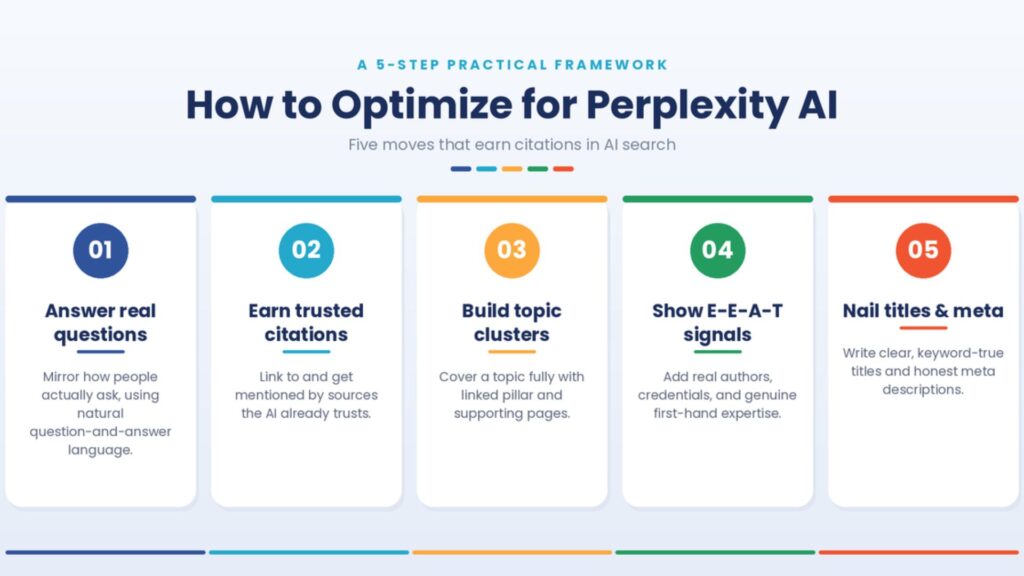
1. Write for the real question, not just the keyword
Perplexity matches content to natural, spoken-style questions from real users. Therefore, mirror how people actually ask things inside your niche. Use question-and-answer patterns and semantic keywords that widen your topic. For example, an article on email automation should mention drip campaigns and lead nurturing. In turn, this richer language helps Perplexity connect your page to more queries. Semrush recommends this exact approach in its perplexity optimization guide.
2. Earn citations from Perplexity’s trusted domains
Links to reputable sources can lift your own visibility surprisingly fast. SEO consultant Ross Kernez tested this idea on a live client site. He replaced vague summaries with direct links to GitHub repos and real product discussions. As a result, his developer content tripled its appearances in Perplexity answers. That is a documented outcome, not a hopeful maybe.
Finding those trusted domains takes a little detective work. Search your niche in Perplexity and note which sites it cites repeatedly. Then reference or earn mentions from those same reputable sources. Over time, this simple habit teaches the engine to trust you too.
3. Build topical authority with content clusters
Perplexity clearly rewards sites that cover a topic from every angle. It reads your work as a connected library, not as isolated pages. Consider the American Kennel Club, which appears twice for puppy-training queries. They earned that by publishing many linked articles on one subject. So build pillar pages, add supporting posts, and link them together tightly.
Smart prompts speed this research up considerably. Our roundup of top AI SEO prompts gives you ready-made starters. Meanwhile, technical setup still matters for the machines reading your site. Our guide on how to optimize your website for AI agents covers schema and llms.txt. Together, these two moves make your pages easy to parse and cite.
4. Show real expertise and E-E-A-T signals
Perplexity and Google both increasingly reward visible, provable expertise. So attach real author names, credentials, and short bios to your content. Cite primary data and link out to trusted references generously. First-hand experience signals authenticity that AI systems can now detect. As a result, honest expert content simply travels further inside answer engines.
5. Nail your titles and meta descriptions
Your snippet is often the only thing a user sees first. So write titles that state the value in plain, honest words. Include your main keyword and skip the clickbait tricks entirely. Your meta description should preview the payoff clearly and simply. Because early engagement feeds ranking, a strong snippet quietly does double duty.
How to Track Your Perplexity Performance
You cannot improve what you do not measure. Since there is no keyword “rank,” focus on citation and referral signals instead:
1. Filter your Google Analytics 4 traffic for perplexity. AI refers to seeing which pages already earn clicks.
2. Search your core questions inside Perplexity each month and note whether you appear in the citations.
3. Watch which new pages start showing up; that tells you what format and topics are working.
4. Double down on what gets cited, and refresh pages that slip out of the answers.
Get Found on Perplexity With Technical Kalyan
Optimizing for Perplexity AI is not about tricks; it is about being the clearest, freshest, and most trustworthy answer to your customer’s question. That takes the right structure, the right technical setup, and steady upkeep. If that feels like a lot to manage alongside running your business, this is exactly the work Technical Kalyan handles for local and growing brands.
Technical Kalyan offers AI-first search services built for the answer-engine era, including:
- AI SEO (AEO & GEO): Getting your business mentioned and cited by Perplexity, ChatGPT, Claude, and Google AI Overviews, plus schema setup and AI brand-mention tracking.
- Local SEO & Google Business Profile: Ranking in the map pack and “near me” searches that bring paying customers in.
- YouTube SEO and Social Media Optimization: Tuned for local discovery and AI-citation-friendly visibility.
You get a clear strategy, plain-English monthly reporting, and no fake ranking guarantees. Want to know where you stand right now? Request a free Local SEO & AI visibility audit from Technical Kalyan and find out exactly which pages are ready to be cited and which need work.
FAQs on Perplexity AI SEO
Q: What is Perplexity AI SEO?
A: Perplexity AI SEO is the practice of optimizing your website so that Perplexity AI can easily find, understand, and cite your content when answering user questions. It focuses on publishing accurate, well-structured, and up-to-date content that directly addresses search intent while making it easy for AI systems to extract reliable information.
Q: How can I get my website cited by Perplexity AI?
A: To get your website cited by Perplexity AI, create content that answers user questions clearly and early in the page. Keep your content updated, organize it with descriptive headings, demonstrate real expertise, and use structured data where appropriate. Building topical authority through related content also increases the likelihood of being selected as a trusted source.
Q: Does Perplexity AI use Google rankings to choose sources?
A: No. Although high-ranking Google pages may sometimes appear in Perplexity AI’s answers, the platform uses its own Retrieval-Augmented Generation (RAG) system to retrieve information from the web. It prioritizes relevance, freshness, credibility, and content quality rather than relying solely on Google’s search rankings.
Q: What type of content does Perplexity AI prefer?
A: Perplexity AI prefers content that provides direct, accurate answers to user questions in a clear and organized format. Pages that use descriptive headings, concise paragraphs, updated information, and credible references and demonstrate first-hand expertise are generally more likely to be cited in AI-generated responses.
Q: Is optimizing for Perplexity AI different from traditional SEO?
A: Yes. Traditional SEO focuses on improving rankings in search engine results, while Perplexity AI optimization aims to make your content easy for AI systems to retrieve, understand, and cite. Although both strategies rely on high-quality content, AI optimization places greater emphasis on answering questions directly, maintaining fresh information, building topical authority, and using a clear content structure.

Kolkata-based SEO consultant and AI Search specialist with 7+ years of experience helping businesses improve their online visibility and organic growth. He specializes in Local SEO, Google Business Profile optimization, AEO, and GEO. With 70+ successful projects across India and international markets, Kalyan helps businesses build stronger visibility across Google Search, Google Maps, ChatGPT, Perplexity, Gemini, Claude, and other AI-powered search platforms. Through Technical Kalyan, he focuses on practical, sustainable search strategies that help local and service-based businesses attract more relevant customers and stay competitive as search continues to evolve in the AI era.