

A practical 2026 guide to making your website easy for AI agents to read, trust, and recommend.
Your customers have stopped scrolling through ten blue links. Instead, they ask ChatGPT, Gemini, or Perplexity a question and act on the answer. Often that answer never mentions your website. In 2026, about 810 million people use ChatGPT every day, and Google AI Overviews reach 1.5 billion users each month.
So one question now shapes your growth: when an AI agent looks for a business like yours, does it find you or your competitor?
Table of Contents
Why 2026 Changed the Rules
Search has shifted faster than most businesses expected. AI Overviews now show up on roughly half of all US searches, up from about 13% in early 2025. Meanwhile, website traffic from AI engines has grown 16 times since 2024. So learning how to rank in AI overviews is now a core skill, not a nice-to-have.
Zero-click behavior is normal now, too. Many people read the AI answer and never click through. So being the trusted source behind that answer matters more than a blue-link ranking.
This shift creates a new kind of visitor: the AI agent. It reads your site, pulls facts, and answers on your behalf. It does not browse like a human. So a page built only for people can still confuse a machine. That is the heart of AI search optimization also called generative engine optimization (GEO). You now write for readers and for the agents that summarize you.
The Real Pain Point: Ranked but Invisible
You can sit at the top of Google and still be missing from AI answers. That gap is the biggest hidden threat to businesses right now.
Here is why it hurts:
- Around 80% of URLs cited by AI tools do not rank in Google’s top 100.
- AI referral traffic often converts about 4x better than normal search clicks.
- 94% of B2B buyers now use AI tools during a purchase.
- AI answers refresh often, so brands drop out of results without warning.
In short, classic SEO gets you ranked. However, it does not always get you recommended. The result is quiet lost revenue that never shows up in your Google rankings. Therefore, you need a second layer, built for machines and not just people.
What AI Agents Actually Need From Your Site
An AI agent does not read your page the way a person does. It scans structure, grabs facts, and moves on quickly. So your job is to make those facts simple to find.
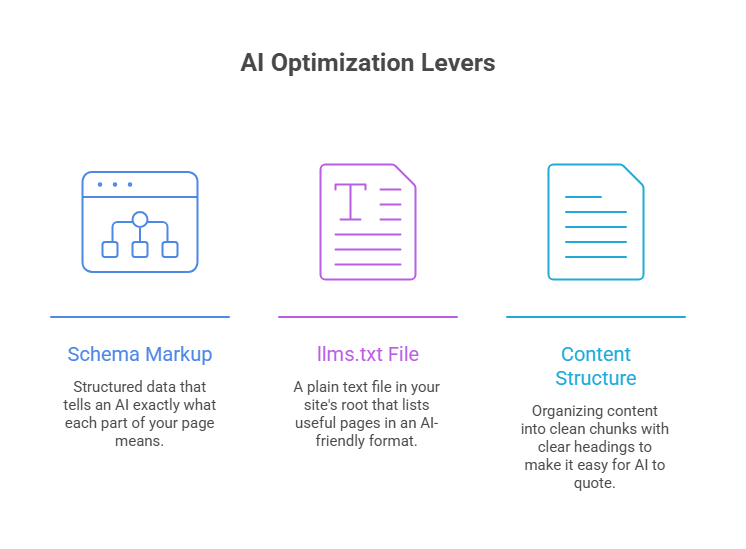
Three levers do most of the work:
I. Schema markup: code that labels your content for machines.
II. llms.txt: a file that points AI to your key pages.
III. Clean content structure: clear headings and direct answers.
Let’s compare them side by side.
| Lever | What it does | Effort | Impact in 2026 |
| Schema markup | Labels facts like price, reviews, FAQs, and location for machines | Medium | High – a proven signal for AI and search |
| llms.txt | Lists your important pages in one AI-friendly file | Low | Low to moderate – still debated |
| Content structure | Clear headings and short answers that AI can quote | Medium | High – good headings lift citations 2.8x |
I. Get Schema Markup Right
Schema markup is structured data. It tells an AI exactly what each part of your page means. For example, it can flag your address, prices, opening hours, and reviews.
Start with these common types:
- Organization and LocalBusiness for your core details
- Product and Review for what you sell
- FAQ Page for the questions people ask
- Article for your blog posts
Machines trust clearly labeled pages more. As a result, AI tools quote them more often. Also, schema still helps you win rich results in normal Google searches. So this lever pays off twice, which makes it a smart first move. Just keep your markup accurate and current, because wrong data can quietly cost you trust.
II. Add llms.txt – With Realistic Expectations
The llms.txt file is a plain text file placed in your site’s root. It lists your most useful pages in a clean, AI-friendly format. Think of it as a menu you hand to AI crawlers.
But here is the honest part. Adoption sits at only about 10% of websites today. Google has also said it does not use llms.txt for search or AI Overviews. Meanwhile, studies show 97% of these files get no AI visits at all.
So should you skip it?
Not quite. The file is cheap to add and easy to update. Some agents and audit tools do read it. Therefore, treat llms.txt as a low-cost bonus, not a magic fix.
III. Structure Content So AI Can Quote It
This lever gives the biggest return of the three. AI agents love content they can lift in one clean chunk.
Build these habits into every page:
- Answer the main question in the first two lines.
- Use short paragraphs and clear subheadings.
- Add simple tables and lists for your facts.
- Keep one idea in each section.
Pages with well-organized headings are 2.8 times more likely to be cited by AI. That single number should shape how you write. So format for clarity first, and better rankings tend to follow.
Your Quick AI-Agent Optimization Checklist
Ready to start? Work through these steps in order:
1. Audit your current visibility across ChatGPT, Gemini, and Perplexity.
2. Add or fix schema markup on your key pages.
3. Publish a clean llms.txt file.
4. Rewrite your top pages with clear answers and headings.
5. Track AI referrals and citations every month.
Does Technical Kalyan Help With This?
Yes, this is exactly what we do. Technical Kalyan is a Local SEO and AI search specialist that helps you get found on Google, ChatGPT, Perplexity, and AI overviews. Our team handles schema markup, llms.txt setup, AI-ready content, Google Business Profile, and clear monthly reporting all in one place.
Want to know where your site stands today? Get your free SEO & AI search audit, with no pitch and no pressure. You can also explore our other digital marketing services to see how we can help your business grow online.

Kolkata-based SEO consultant and AI Search specialist with 7+ years of experience helping businesses improve their online visibility and organic growth. He specializes in Local SEO, Google Business Profile optimization, AEO, and GEO. With 70+ successful projects across India and international markets, Kalyan helps businesses build stronger visibility across Google Search, Google Maps, ChatGPT, Perplexity, Gemini, Claude, and other AI-powered search platforms. Through Technical Kalyan, he focuses on practical, sustainable search strategies that help local and service-based businesses attract more relevant customers and stay competitive as search continues to evolve in the AI era.