
Your website might look great. Yet if Google can’t read it, your customers won’t find it. That hidden gap costs real sales every day, and most owners never see it coming.
So, what is an SEO audit?
It’s a health check for your website. It shows what stops your pages from ranking on Google and appearing in AI answers. Then it tells you what to fix first.
Table of Contents
What Is a Free SEO Audit in Simple English?
A free SEO audit is a full review of how well search engines can find, read, and trust your website. Think of it as a yearly checkup at the doctor. Instead of judging your site, it spots problems early, before they cost you traffic and leads.
SEO stands for search engine optimization. Simply put, it means shaping your site so Google, Bing, and AI tools show it to the right people. An audit looks at every part that affects this, from page speed to the words on each page.
So, what is an SEO audit really for?
It answers three simple questions. Can search engines reach your pages? Do those pages answer what people search for? And do other sites and customers trust you enough to send visitors your way?
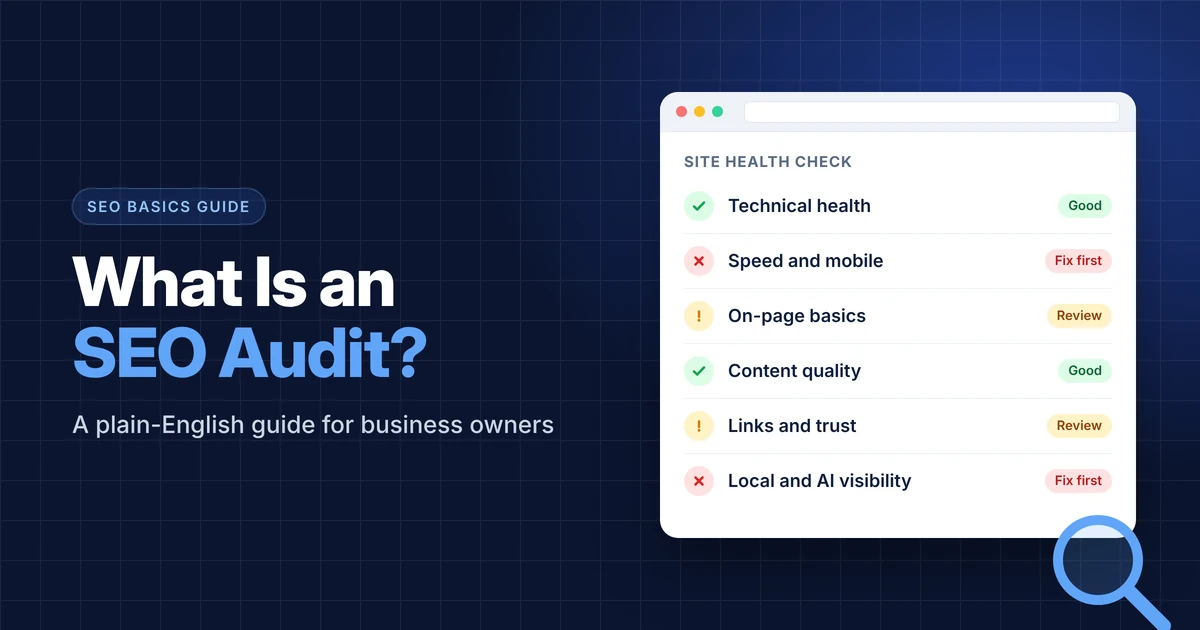
The Six Areas an Audit Checks
Most audits look at the same core areas. Each one covers a different reason a page might not rank.
- Technical health: Can Google crawl and index your pages? Are there broken links, redirect loops, or blocked pages?
- Speed and mobile use: Do your pages load fast and work well on a phone?
- On-page basics: Do your titles, headings, and meta descriptions match what people search for?
- Content quality: Does each page answer a real question better than the pages that outrank it?
- Links and trust: Which sites link to you, and do any of those links look spammy?
- Local and AI visibility: Is your Google Business Profile complete, and do AI tools mention your brand?
A good audit doesn’t treat these as separate boxes. For example, a slow page can sink great content. That’s why the review looks at your whole site together.
Why It Matters More in 2026
Search has changed fast in the last two years. Google now shows AI summaries above many results. In fact, Google’s AI Overviews passed 2 billion monthly users by July 2025.
Those summaries change how people click. A Pew Research Center study of 900 US adults found users clicked a regular result in just 8% of visits with an AI summary. Without one, they clicked 15% of the time. Likewise, Ahrefs found that AI Overviews linked to a 58% lower click rate for the top result in December 2025.
Google also keeps changing its rules. It rolled out three core updates in 2025. So far in 2026, it has released two more core updates and four spam updates, according to the Google Search Status Dashboard. Each one can move your rankings, sometimes overnight.
Meanwhile, many sites still fail basic speed tests. The 2025 Web Almanac found that only 48% of mobile websites had good Core Web Vitals. In other words, about half the web still loads too slowly or shifts around on phones.
The good news?
There’s no secret trick for AI results. Google’s own guide says the same SEO basics help you appear in AI Overviews. So, what is an SEO audit worth in 2026? Often, it’s the difference between being the answer and being skipped.
How an SEO Audit Works, Step by Step
So, what is an SEO audit in practice? It’s a simple five-step process that most experts follow.
- Set the goal: First, decide what matters most to you, such as more calls, sales, or store visits.
- Crawl the site: Next, a tool scans every page, just like Google’s bot does.
- Check the data: Then the auditor reviews Google Search Console, analytics, and speed reports.
- Compare with competitors: This step shows who outranks you and why.
- Rank the problems: Finally, the auditor sorts each issue by impact, so you fix the biggest ones first.
The last step matters most. After all, a list of 300 errors helps no one. A short, ranked fix list helps you act this week.
What an SEO Audit Report Includes
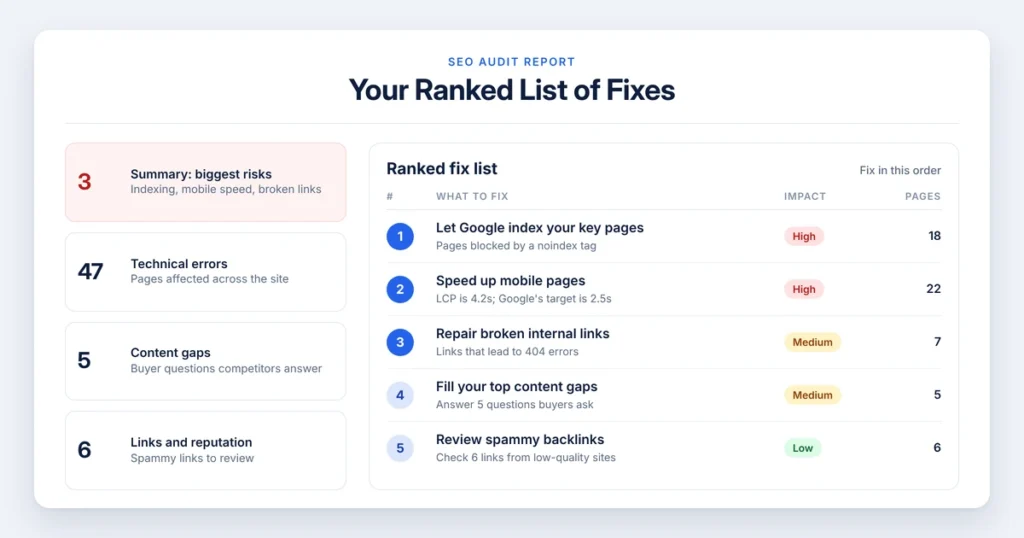
At the end, you get an SEO audit report. A good one reads like a plan, not a pile of data. Most reports cover these five parts:
- A short summary of your site’s health and biggest risks
- A list of technical errors, with the pages they affect
- Content gaps, where competitors answer questions you don’t
- A look at your links and online reputation
- A ranked fix list that shows what to do first, second, and third
Be careful with reports that only show a score. A grade of 72 out of 100 tells you very little. Instead, look for clear steps that you or your developer can follow.
SEO Audit Tools and Checkers
You don’t need to be an expert to get started. Many SEO audit tools do the heavy lifting for you. Some are free, while others charge a monthly fee.
| Tool | What it checks | Cost |
| Google Search Console | Indexing errors, search clicks, and Core Web Vitals | Free |
| PageSpeed Insights | Page speed against Google’s targets | Free |
| Screaming Frog SEO Spider | Broken links, missing titles, and redirect errors | Free up to 500 URLs |
| Semrush or Ahrefs site audit | Full site health, with scores and fix tips | Limited free use; paid plans |
An SEO audit checker gives you a fast first look. However, tools can’t judge what matters for your business. They often flag hundreds of issues, and many are false alarms. That’s where a human review adds real value.
Free vs. Paid Audits
A free SEO audit is a smart place to start. Many agencies and tools offer one. It usually covers your top issues and gives you a quick health score.
A paid audit, on the other hand, goes much deeper. It often adds keyword research, a full content review, link analysis, and a month-by-month plan. Prices vary a lot, so always ask what’s included before you pay.
So which one do you need? If your site is small and new, a free audit may be enough. But if your traffic dropped or you plan a redesign, a full audit usually pays for itself.
How Often Should You Run One?
Most businesses should run a full audit once or twice a year. In between, check Google Search Console each month for new errors.
Also, run an extra audit after any big change. That includes a site redesign, a move to a new domain, or a sudden drop in traffic. Google’s frequent updates give you one more reason to check in often.
A Simple SEO Audit Checklist
Want to try a quick check yourself? This basic SEO audit checklist covers the essentials.
- Confirm that Google has indexed your key pages in Search Console.
- Fix any broken links and 404 errors.
- Give every page a unique title and meta description.
- Use one clear H1 heading on each page.
- Test your speed against Google’s Core Web Vitals targets: LCP within 2.5 seconds, INP under 200 milliseconds, and CLS under 0.1.
- Open your site on a phone and make sure it’s easy to use.
- Look for thin or outdated pages that need a refresh.
- Check that your business name, address, and phone number match everywhere online.
Of course, this list won’t catch everything. Still, it will quickly show you whether a deeper review is worth it.
Get Your SEO Audit Done Right
An SEO audit takes the guesswork out of growing online. It shows what’s broken, what’s working, and what to fix first. If you’d rather have experts handle it, Technical Kalyan can help. Our team reviews your site by hand, ranks each issue by impact, and turns the findings into a clear action plan. Book your free SEO audit and consultation with Technical Kalyan today and see exactly what’s holding your website back.
Frequently Asked Questions
Q: What is an SEO audit in simple terms?
A: It’s a checkup for your website. It finds what stops your pages from showing up on Google and in AI answers, then ranks the fixes by importance.
Q: What is an SEO audit report?
A: It’s the document you get at the end of the audit. It lists the problems found, the pages they affect, and a clear order for fixing them.
Q: How long does an SEO audit take?
A: A basic audit of a small website often takes a few days. By contrast, a large site with thousands of pages can take several weeks.
Q: Is a free SEO audit worth it?
A: Yes, as a first step. It shows your biggest issues at no cost. However, it won’t replace a full review if your site has serious problems.
Q: Can I do an SEO audit myself?
A: Yes, you can. Free tools like Google Search Console and PageSpeed Insights cover the basics. For a complex site, though, an expert will spot issues that tools miss.
Q: Does an SEO audit help with AI search?
A: Yes. Google says the same SEO basics help you appear in AI Overviews. So, fixing what an audit finds also helps AI tools read and trust your site.

Kolkata-based SEO consultant and AI Search specialist with 7+ years of experience helping businesses improve their online visibility and organic growth. He specializes in Local SEO, Google Business Profile optimization, AEO, and GEO. With 70+ successful projects across India and international markets, Kalyan helps businesses build stronger visibility across Google Search, Google Maps, ChatGPT, Perplexity, Gemini, Claude, and other AI-powered search platforms. Through Technical Kalyan, he focuses on practical, sustainable search strategies that help local and service-based businesses attract more relevant customers and stay competitive as search continues to evolve in the AI era.